


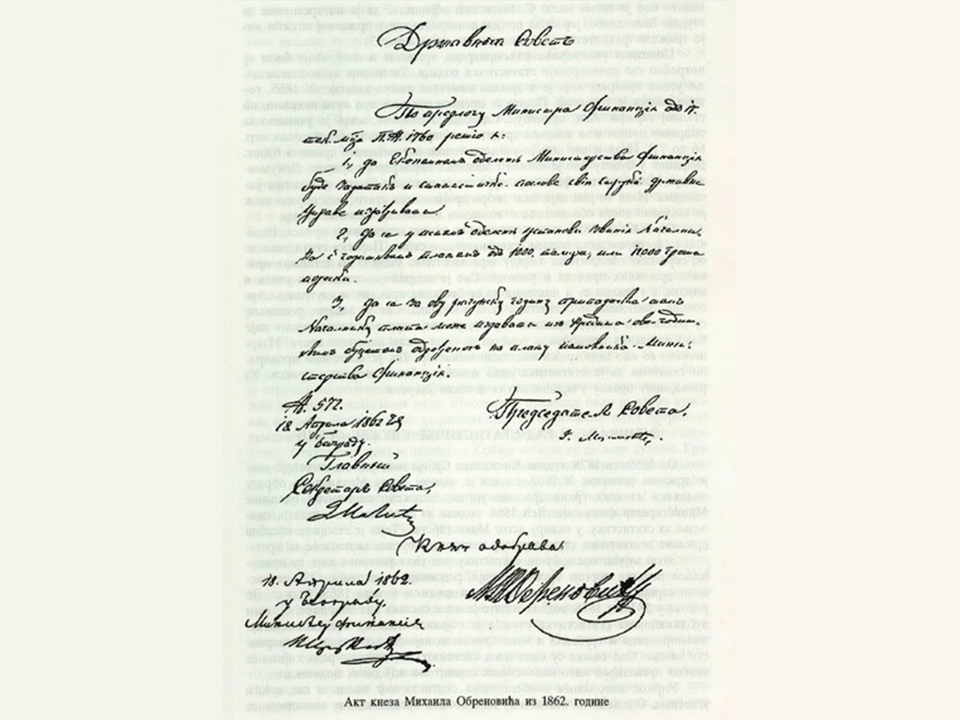
The State Statistical Service of Serbia was founded in 1862, when Prince Mihailo Obrenovic signed an act by which the Economic Department of the Ministry of Finance obliged to manage and coordinate all statistical affairs for all branches of the state administration.
All the achievements of statistical surveys until the First World War are in the editions of the State Statistics of Serbia, and there were twenty of them. The first State Statistics of Serbia was published in 1863. Publication of the State Statistics of Serbia had certainly contributed to the creation of systematics and continuity in the work of the statistical service, and transition to the regular publication of the yearbook showed stabilization of data collection methods.
The first Statistical Yearbook of the Kingdom of Serbia was published in 1895 and had 392 pages divided into 19 chapters. The last Statistical Yearbook of the Kingdom of Serbia related to 1909-1910, and was printed on 848 pages
With the outbreak of the First World War, the activities of national statistics in Serbia were interrupted, and in 1919, a decision was made to establish a Directorate of National Statistics at the Ministry of Social Policy of the Kingdom of Serbs, Croats and Slovenes.
The statistics between the two wars carried out two population censuses, in 1921 and 1931, and the second census also included census of agriculture. The data were thoroughly processed, and the final results of 1921 census were published later, in 1932, and previous results were published in several books, in 1924, 1927, and 1931. The first Statistical Yearbook of the Kingdom of Yugoslavia was issued in 1929 and until the outbreak of the Second World War, 10 yearbooks were issued.
The decision to establish the State Statistical Office was made on 12th December 1944. The Statistical Office of the Republic of Serbia was established in 1945 and it published the results of all surveys, and the Statistical Yearbook, Yearbook of Municipalities, Bulletins and other publications, thus providing extensive documentation to the public on the course of Serbia's development.
The role and importance of statistics in contemporary society is firstly reflected in the provision of timely, accurate and reliable data and information. Thanks to the development of information and communication technologies, official statistics is able to collect, process and disseminate a great number of data and information.
As the main producer and disseminator of official statistics, the Statistical Office of the Republic of Serbia has been devoted to improving the quality of statistical processes in recent years. In order to meet users’ needs, the new website was created, and a unique dissemination database was significantly enhanced, so that users can search and download longer data series.
Strategic goals for further development of the Statistical Office of the Republic of Serbia:
Since its establishing until today, the statistical system of Serbia has undergone many systemic changes, but it has achieved an extremely high degree of expertise, which is confirmed by the Eurostat reports and reports of other bodies of the European Commission, the United Nations, the International Monetary Fund, and others.